Quick Answer: Most common-date Standing Liberty Quarters in circulated condition are worth $15–$50, driven primarily by their 90% silver content (melt value around $5–$6 per coin at current silver prices). Key dates like the 1916 ($5,000–$25,000+), 1918/7-S overdate ($1,600–$150,000+), and 1927-S ($55–$16,000+) command serious premiums. Coins with the coveted Full Head (FH) designation can be worth 2–10x more than non-FH examples of the same date and grade.
The Standing Liberty Quarter is widely considered one of the most beautiful coins ever produced by the U.S. Mint. Designed by sculptor Hermon Atkins MacNeil and minted from 1916 to 1930, it features a stunning depiction of Liberty in a classical, almost Greek-style pose — standing in a gateway, holding an olive branch of peace and a shield of protection. The reverse showcases a majestic eagle in full flight. Struck in 90% silver, these quarters replaced the long-running Barber quarter and remain a cornerstone of American numismatics, prized by collectors for their artistry, historical significance, and genuinely scarce key dates.
Standing Liberty Quarter Design and Specifications
Hermon Atkins MacNeil was already well-known for his sculptural works depicting Native American subjects when he won the design competition for the new quarter dollar in 1916. His design drew inspiration from ancient Greek and Roman coinage, presenting Liberty not as a seated or walking figure but as a standing sentinel.
| Specification | Details |
|---|---|
| Composition | 90% silver, 10% copper |
| Weight | 6.25 grams |
| Diameter | 24.3 mm |
| Edge | Reeded |
| Silver Content | 0.1808 troy oz (0.1627 oz pure silver) |
| Designer | Hermon Atkins MacNeil |
| Minting Years | 1916–1930 |
| Mints | Philadelphia (no mint mark), Denver (D), San Francisco (S) |
Type 1 vs. Type 2 (1917 Transition)
The series includes two major design types, both produced in 1917:
- Type 1 (1916–1917): Liberty's right breast is partially exposed in the original design. The reverse features three stars below the eagle. Only 52,000 were struck in 1916 (all at Philadelphia), making the 1916 one of the most famous key dates in all of U.S. coinage.
- Type 2 (1917–1930): After public criticism of the exposed design, MacNeil modified the obverse to cover Liberty's breast with chain mail armor. The reverse was also reworked — the three stars were repositioned above the eagle. This design continued through the end of the series in 1930.
The Recessed Date Change (1925)
A persistent problem with the Standing Liberty Quarter was rapid date wear. The original design placed the date on a raised area that wore down quickly in circulation, leaving many coins dateless after only a few years of use. Starting in 1925, the Mint recessed the date into the coin's surface, dramatically improving its durability. Coins from 1925–1930 are far more likely to retain readable dates even in well-circulated condition.
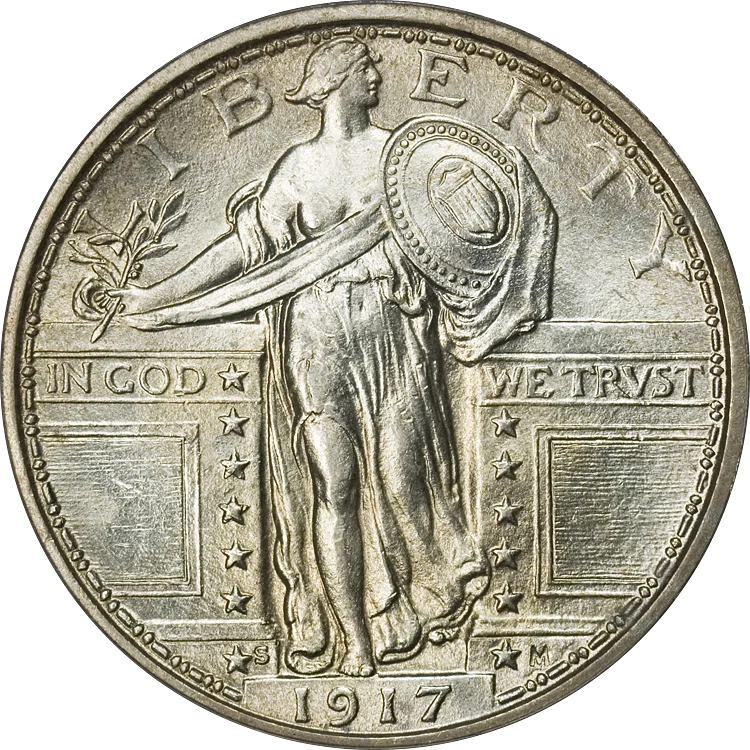
1917-S Standing Liberty Quarter, Type 1 obverse (MS-63 FH). Photo by John Baumgart, sourced from Wikimedia Commons (CC BY-SA 3.0).
Standing Liberty Quarter Value Chart: Common Dates
The majority of Standing Liberty Quarters from the mid-1920s through 1930 are considered common dates. Even so, their 90% silver content provides a price floor, and collector demand keeps circulated examples well above melt value.
| Grade | Value Range |
|---|---|
| Dateless (date worn off) | $4–$6 (silver value) |
| About Good (AG-3) | $8–$15 |
| Good (G-4) | $15–$25 |
| Very Good (VG-8) | $20–$35 |
| Fine (F-12) | $25–$45 |
| Very Fine (VF-20) | $35–$60 |
| Extremely Fine (EF-40) | $50–$90 |
| About Uncirculated (AU-50) | $75–$140 |
| Uncirculated (MS-60) | $120–$200 |
| Choice Uncirculated (MS-63) | $175–$350 |
| Gem Uncirculated (MS-65) | $400–$800 |
| Superb Gem (MS-66+) | $800–$2,000+ |
These values apply to dates like 1925, 1926-P, 1928, 1929, and 1930 Philadelphia issues. Full Head examples command significant premiums at every grade level above VF.
Key Date Standing Liberty Quarter Values
Key dates are where the real excitement — and investment potential — lives in this series. Low mintages, striking challenges, and high attrition rates have left surprisingly few survivors in collectible grades.
1916 Standing Liberty Quarter Value
The 1916 is the undisputed key date of the series. With a mintage of just 52,000 coins — all struck at Philadelphia — it is one of the most sought-after 20th-century U.S. coins. The coin was released so late in the year that most examples entered circulation quickly and were heavily worn before collectors recognized their importance.
| Grade | Value Range |
|---|---|
| About Good (AG-3) | $3,500–$5,000 |
| Good (G-4) | $5,000–$7,000 |
| Very Good (VG-8) | $6,000–$8,500 |
| Fine (F-12) | $7,500–$10,000 |
| Very Fine (VF-20) | $8,500–$12,000 |
| Extremely Fine (EF-40) | $10,000–$15,000 |
| About Uncirculated (AU-50) | $14,000–$18,000 |
| Uncirculated (MS-63) | $18,000–$25,000 |
| Gem Uncirculated (MS-65) | $40,000–$75,000+ |
Authentication is critical for this date. PCGS and NGC certification is essential before buying or selling, as counterfeits and altered 1917 coins (with the "7" tooled to look like a "6") are extremely common.
1918/7-S Overdate Value
The 1918/7-S is the most famous variety in the Standing Liberty Quarter series and one of the great rarities of 20th-century American coinage. A San Francisco Mint die was first impressed with a 1917-dated hub, then re-impressed with a 1918-dated hub. The traces of the underlying "7" are clearly visible beneath the "8" in the date on genuine examples.
| Grade | Value Range |
|---|---|
| About Good (AG-3) | $1,600–$2,500 |
| Good (G-4) | $2,500–$4,000 |
| Very Good (VG-8) | $3,500–$5,500 |
| Fine (F-12) | $5,000–$8,000 |
| Very Fine (VF-20) | $7,500–$12,000 |
| Extremely Fine (EF-40) | $12,000–$20,000 |
| About Uncirculated (AU-50) | $25,000–$40,000 |
| Uncirculated (MS-63) | $30,000–$60,000 |
| Gem Uncirculated (MS-65 FH) | $150,000–$350,000+ |
Numismatic scholars estimate fewer than 1,000 examples survive in all grades combined. A PCGS MS-64+ Full Head specimen sold for $336,000 at auction in 2020. Authentication diagnostics include a die clash visible near Liberty's right knee and a small pimple of extra metal above and to the right of the final date digit.
1927-S Value
The 1927-S has the lowest mintage of any regular-issue Standing Liberty Quarter at just 396,000 coins. It is genuinely rare in all grades and extremely rare with Full Head detail.
| Grade | Value Range |
|---|---|
| About Good (AG-3) | $50–$100 |
| Good (G-4) | $100–$200 |
| Very Good (VG-8) | $200–$400 |
| Fine (F-12) | $500–$1,000 |
| Very Fine (VF-20) | $1,200–$2,500 |
| Extremely Fine (EF-40) | $3,000–$6,000 |
| About Uncirculated (AU-50) | $5,000–$9,000 |
| Uncirculated (MS-63) | $8,000–$16,000 |
| Gem Uncirculated (MS-65) | $25,000–$50,000+ |
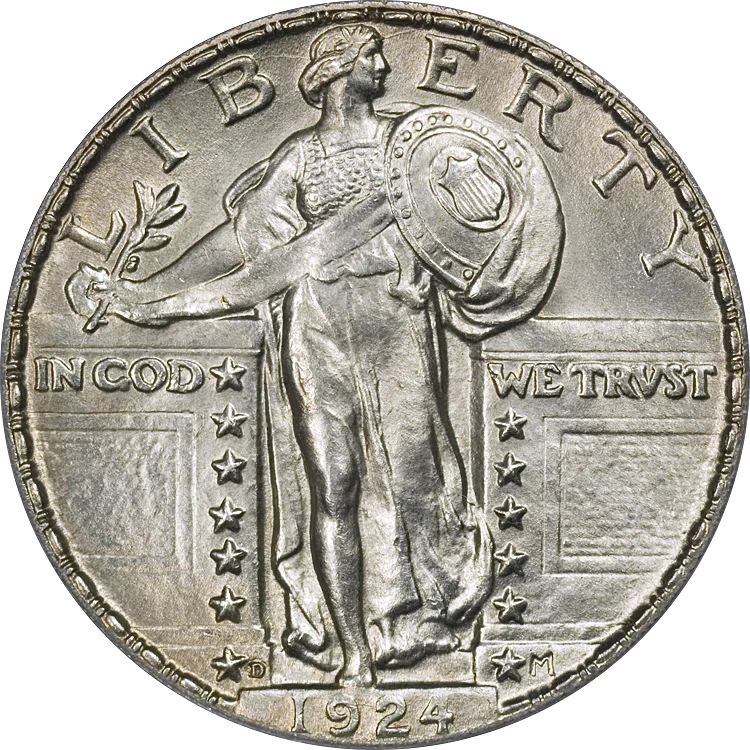
1924-D Standing Liberty Quarter, Type 2 obverse (MS-63 FH). Photo by John Baumgart, sourced from Wikimedia Commons (CC BY-SA 3.0).
Complete Standing Liberty Quarter Value by Year
1916–1917: The First Years
All 1916 and 1917 varieties carry collector premiums. The 1916 is the series key date, and the 1917 issues are split between Type 1 and Type 2 designs.
| Date & Type | Mintage | G-4 | VF-20 | MS-63 |
|---|---|---|---|---|
| 1916 (Type 1) | 52,000 | $5,000–$7,000 | $8,500–$12,000 | $18,000–$25,000 |
| 1917 Type 1 | 8,740,000 | $20–$30 | $50–$75 | $250–$400 |
| 1917-D Type 1 | 1,509,200 | $25–$40 | $70–$110 | $350–$500 |
| 1917-S Type 1 | 1,952,000 | $25–$40 | $65–$100 | $275–$450 |
| 1917 Type 2 | 13,880,000 | $20–$30 | $45–$65 | $200–$350 |
| 1917-D Type 2 | 6,224,400 | $25–$40 | $60–$100 | $350–$550 |
| 1917-S Type 2 | 5,552,000 | $25–$40 | $55–$90 | $300–$500 |
1918–1919: Early Production
These years include the famous 1918/7-S overdate and several scarce branch-mint issues. San Francisco and Denver coins from this period are consistently undervalued relative to their true scarcity.
| Date | Mint | Mintage | G-4 | VF-20 | MS-63 |
|---|---|---|---|---|---|
| 1918 | P | 14,240,000 | $18–$25 | $40–$65 | $200–$350 |
| 1918-D | D | 7,380,800 | $20–$30 | $50–$80 | $350–$550 |
| 1918-S | S | 11,072,000 | $18–$28 | $45–$70 | $250–$400 |
| 1918/7-S | S | Unknown (rare) | $2,500–$4,000 | $7,500–$12,000 | $30,000–$60,000 |
| 1919 | P | 11,324,000 | $20–$30 | $45–$70 | $200–$350 |
| 1919-D | D | 1,944,000 | $40–$70 | $150–$300 | $1,200–$2,000 |
| 1919-S | S | 1,836,000 | $40–$65 | $130–$250 | $1,500–$2,500 |
1920–1924: Semi-Key Dates
The early 1920s produced several dates that are genuinely scarce, particularly the 1921 (low mintage of 1,916,000) and the 1923-S. Note that no Standing Liberty Quarters were struck in 1922.
| Date | Mint | Mintage | G-4 | VF-20 | MS-63 |
|---|---|---|---|---|---|
| 1920 | P | 27,860,000 | $15–$25 | $35–$55 | $175–$300 |
| 1920-D | D | 3,586,400 | $25–$45 | $65–$120 | $400–$700 |
| 1920-S | S | 6,380,000 | $18–$30 | $45–$80 | $350–$600 |
| 1921 | P | 1,916,000 | $50–$90 | $175–$325 | $700–$1,200 |
| 1923 | P | 9,716,000 | $15–$25 | $35–$55 | $175–$300 |
| 1923-S | S | 1,360,000 | $100–$175 | $350–$600 | $1,500–$3,000 |
| 1924 | P | 10,920,000 | $15–$25 | $35–$55 | $175–$300 |
| 1924-D | D | 3,112,000 | $25–$45 | $60–$100 | $350–$600 |
| 1924-S | S | 2,860,000 | $18–$30 | $50–$85 | $350–$600 |
Note: No Standing Liberty Quarters were struck in 1922 at any mint.
1925–1930: Recessed Date Era
Starting in 1925, the date was recessed into the coin's surface, dramatically reducing date wear. These later dates are generally the most affordable in the series, though branch-mint issues from 1926 and 1927 can be surprisingly scarce.
| Date | Mint | Mintage | G-4 | VF-20 | MS-63 |
|---|---|---|---|---|---|
| 1925 | P | 12,280,000 | $8–$15 | $25–$40 | $175–$275 |
| 1926 | P | 11,316,000 | $8–$15 | $25–$40 | $175–$275 |
| 1926-D | D | 1,716,000 | $10–$18 | $35–$60 | $250–$450 |
| 1926-S | S | 2,700,000 | $8–$15 | $25–$40 | $200–$350 |
| 1927 | P | 11,912,000 | $8–$15 | $25–$40 | $175–$275 |
| 1927-D | D | 976,000 | $15–$30 | $50–$90 | $350–$650 |
| 1927-S | S | 396,000 | $100–$200 | $1,200–$2,500 | $8,000–$16,000 |
| 1928 | P | 6,336,000 | $8–$15 | $25–$40 | $175–$275 |
| 1928-D | D | 1,627,600 | $8–$15 | $30–$50 | $200–$350 |
| 1928-S | S | 2,644,000 | $8–$15 | $25–$40 | $200–$350 |
| 1929 | P | 11,140,000 | $8–$15 | $25–$40 | $175–$275 |
| 1929-D | D | 1,358,000 | $10–$18 | $30–$50 | $200–$350 |
| 1929-S | S | 1,764,000 | $8–$15 | $28–$45 | $200–$350 |
| 1930 | P | 5,632,000 | $8–$15 | $25–$40 | $175–$275 |
| 1930-S | S | 1,556,000 | $8–$15 | $28–$45 | $200–$350 |
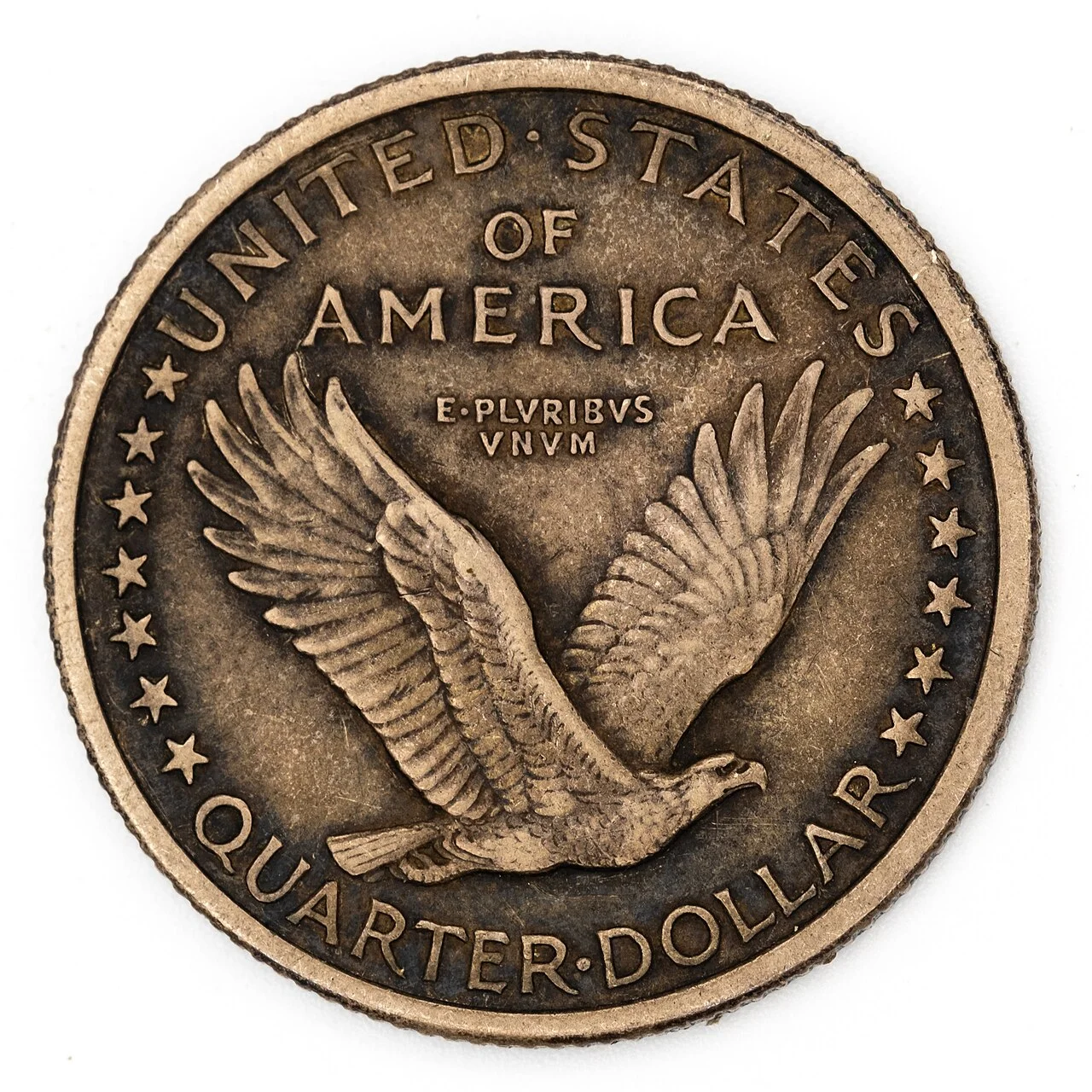
1917 Standing Liberty Quarter reverse. Photo sourced from Wikimedia Commons (CC BY-SA 4.0).
The Full Head (FH) Designation: Why It Matters
The Full Head designation is one of the most important factors in Standing Liberty Quarter values. Awarded by PCGS and NGC, it indicates that Liberty's head is fully struck with all intended design details visible. Coins with the FH designation routinely sell for 2–10 times more than non-FH examples of the same date, mint mark, and grade.
Full Head Criteria
Type 1 (1916–1917):
- Clear and distinct separation between Liberty's hair cords and her cap
Type 2 (1917–1930):
- Three complete and distinct leaves visible in the hair/helmet
- Complete outline along the bottom of the helmet
- Clear ear hole visible on Liberty's head
Why Full Head Examples Are Scarce
Standing Liberty Quarters are notorious for weak strikes, particularly on the head of Liberty. The head is the highest point on the obverse and sits directly opposite the eagle's body on the reverse — two high-relief areas competing for metal flow during striking. Branch-mint coins (Denver and San Francisco) tend to be more weakly struck than Philadelphia issues, making FH examples from those mints especially scarce.
Full Head Premium Examples
| Date | Non-FH MS-65 | FH MS-65 | Premium |
|---|---|---|---|
| 1917 Type 1 | $500–$700 | $900–$1,500 | 2–3x |
| 1924-D | $450–$600 | $2,000–$4,000 | 4–7x |
| 1926-D | $350–$500 | $3,000–$6,000 | 8–12x |
| 1927 | $350–$500 | $600–$1,000 | 2x |
| 1929-S | $400–$600 | $1,500–$3,000 | 3–5x |
Only about 2% of graded 1926-D quarters have received the FH designation, making Full Head examples of that date exceptionally scarce. In contrast, Philadelphia Mint coins from 1925, 1929, and 1930 are more commonly found with Full Head detail.
Errors and Varieties Worth Money
| Error/Variety | Date | Value Range |
|---|---|---|
| 1918/7-S Overdate | 1918-S | $1,600–$350,000+ |
| 1917 Type 1 Doubled Die Obverse | 1917 | $200–$5,000+ |
| Off-Center Strikes (5–15%) | Various | $50–$500+ |
| Broadstrikes (no collar) | Various | $75–$400 |
| Clipped Planchets | Various | $30–$200 |
| Die Cuds (major) | Various | $50–$500+ |
| Rotated Dies | Various | $25–$200 |
| Lamination Errors | Various | $25–$150 |
| Wrong Planchet Strikes | Various | $1,000–$10,000+ |
How to Authenticate the 1918/7-S Overdate
Counterfeits of this valuable variety are common. Look for these diagnostic features on genuine examples:
- The "7" beneath the "8": On authentic specimens, the underlying "7" from the first hubbing is visible beneath the final "8" in the date
- Die clash near Liberty's right knee: A diagnostic clash mark is visible even on well-worn examples (Good grade)
- Extra metal pimple: A small raised dot appears above and to the right of the final date digit
- Die state markers: Genuine examples show consistent die markers that experts use for authentication
Professional certification by PCGS or NGC is absolutely essential before buying any coin claimed to be a 1918/7-S.
How to Grade Standing Liberty Quarters
Grading is essential for determining value — a single grade point can mean hundreds or thousands of dollars on key dates. The Sheldon scale runs from 1 to 70.
Key Wear Points
- Liberty's head and helmet: The highest point on the obverse — this is where wear appears first and where the Full Head designation is evaluated
- Shield rivets and center: Show wear early in circulation
- Liberty's right knee: High point that flattens quickly
- Eagle's breast feathers: The first area to show wear on the reverse
- Date: On pre-1925 coins, the raised date wears rapidly; post-1925 recessed dates hold up much better
Quick Grading Reference
| Grade | What to Look For |
|---|---|
| About Good (AG-3) | Outline visible, date partially readable (pre-1925) or readable (post-1925), most detail worn smooth |
| Good (G-4) | Date fully readable, rim intact, Liberty's outline clear, shield visible but flat |
| Very Good (VG-8) | Some gown lines visible, date clear, partial shield detail |
| Fine (F-12) | Gown lines visible above knee, shield shows moderate detail, some helmet detail visible |
| Very Fine (VF-20) | Most gown lines sharp, shield nearly complete, knee slightly flat, some head detail |
| Extremely Fine (EF-40) | All design elements visible with light wear on high points — head, knee, shield center |
| About Uncirculated (AU-50) | Trace wear on head and knee only, substantial luster remaining |
| Uncirculated (MS-60+) | No wear; graded by luster, strike quality, and contact marks |
Strike Quality Is Critical
Standing Liberty Quarters are among the most strike-sensitive coins in U.S. numismatics. A weakly struck MS-65 can be worth far less than a well-struck MS-63 of the same date. When evaluating these coins, always assess the head detail (Full Head potential), the shield rivets, and the eagle's breast feathers on the reverse. Branch-mint coins from the early 1920s are particularly prone to weak strikes.
The Dateless Quarter Problem
Like buffalo nickels, Standing Liberty Quarters suffer from a dateless coin problem — but only for pre-1925 issues. The raised date on Type 1 and early Type 2 coins wore away quickly in circulation. Millions of these coins survive with dates too worn to read.
Dateless Standing Liberty Quarter Values
Dateless examples are worth their silver content — approximately $4–$6 depending on the current silver price. While the coin is identifiable as a Standing Liberty Quarter, without a readable date it's impossible to determine the year or mint, eliminating any numismatic premium.
Identifying the Date on Worn Coins
If you have a Standing Liberty Quarter with a partial date, examine it under magnification and angled lighting. Even faint traces of date digits can narrow the possibilities. CoinID's AI-powered identification can help you determine whether any date remnants are visible and suggest possible date ranges based on the coin's overall wear pattern and design details.
Silver Melt Value
Every Standing Liberty Quarter contains 0.1808 troy ounces of silver (90% silver composition). At current silver prices, the base melt value is approximately $5–$6 per coin. This provides a solid price floor — even the most common, well-worn examples will never be worth less than their silver content.
| Silver Price per Troy Oz | Quarter Melt Value |
|---|---|
| $25 | $4.07 |
| $30 | $4.88 |
| $35 | $5.70 |
| $40 | $6.51 |
| $45 | $7.32 |
Standing Liberty Quarter Collecting Strategies
Strategy 1: Type Set (Budget-Friendly)
Collect one Type 1 and one Type 2 example. A Type 1 1917-P in VG and a Type 2 1925-P in VF would cost approximately $60–$100 total and represent both major design variations.
Strategy 2: One Per Year (Moderate Budget)
Collect one quarter for each year minted (1916–1930, excluding 1922). The 1916 key date makes a complete date set expensive. Skipping the 1916 and 1918/7-S, the remaining dates can be assembled in Fine to VF condition for $1,000–$3,000.
Strategy 3: Complete by Date and Mint Mark
A full date-and-mint-mark set comprises approximately 36 coins (including both 1917 types). In circulated grades (VG to Fine), expect to spend $10,000–$25,000 with the 1916, 1918/7-S, and 1927-S accounting for most of the cost.
Strategy 4: Full Head Collection
The ultimate challenge: assembling a complete set with Full Head designation. This is one of the most difficult and expensive collecting goals in U.S. numismatics. Several dates are virtually unobtainable in FH (particularly the 1926-D and certain San Francisco issues).
Estimated Budget by Completion Level
| Collection Goal | Estimated Cost |
|---|---|
| Type set (1 each Type 1 & 2), VG-VF | $60–$100 |
| One per year (excl. 1916), Fine | $1,000–$3,000 |
| Complete by date/mint, VG-Fine | $10,000–$25,000 |
| Complete by date/mint, MS-63 | $75,000–$150,000+ |
| Complete by date/mint, MS-65 FH | $500,000+ |
Where to Buy Standing Liberty Quarters
Coin Dealers and Shows
Established coin dealers stock common-date Standing Liberty Quarters regularly. Regional and national coin shows (such as the ANA World's Fair of Money) are ideal for finding key dates and comparing offerings from multiple dealers.
Online Auctions and Marketplaces
- Heritage Auctions: The premier auction house for certified Standing Liberty Quarters, especially key dates and Full Head examples
- eBay: Wide selection at all price points — always buy PCGS/NGC certified coins for purchases over $50
- Great Collections: Online auction site specializing in certified U.S. coins with competitive prices
Estate Sales and Inherited Collections
Standing Liberty Quarters frequently turn up in inherited coin collections. If you've received a jar or album of old quarters, identifying dates and mint marks is the first step. Many inherited Standing Liberty Quarters are dateless — but the ones with readable dates could be valuable key dates. CoinID can instantly identify each coin from a photo, saving hours of manual sorting and giving you current market values.
Standing Liberty Quarter Investment Outlook
Standing Liberty Quarters have strong long-term investment fundamentals:
- Intrinsic silver value: Every coin contains nearly a fifth of an ounce of silver, providing a hard floor on value
- Iconic design: Consistently ranked among the most beautiful U.S. coin designs ever produced
- Finite supply: No more will be made, and high-grade/FH examples are permanently absorbed into collections
- Active collector base: The series has a dedicated following among both type collectors and series specialists
- Condition scarcity: Many dates are common in low grades but genuinely rare in Mint State with Full Head detail
- Key date appreciation: The 1916, 1918/7-S, and 1927-S have shown consistent price appreciation over decades
Frequently Asked Questions
How much is a Standing Liberty Quarter worth?
Most common-date Standing Liberty Quarters in circulated condition are worth $15–$50. The silver content alone makes each coin worth approximately $5–$6. Key dates like the 1916, 1918/7-S overdate, and 1927-S can be worth thousands to hundreds of thousands of dollars depending on grade.
What is the most valuable Standing Liberty Quarter?
The 1918/7-S overdate in gem Mint State with Full Head designation is the most valuable, with examples selling for over $300,000. Among regular issues, the 1916 quarter (mintage: 52,000) commands $5,000+ even in About Good condition.
What does "Full Head" mean on a Standing Liberty Quarter?
Full Head (FH) is a designation awarded by PCGS and NGC indicating that Liberty's head is fully struck. On Type 2 coins, this means three complete leaves in the helmet, a complete helmet outline, and a visible ear hole. FH coins typically sell for 2–10 times more than non-FH examples.
How can I tell if my Standing Liberty Quarter is valuable?
Check the date (if readable) and the mint mark, located on the obverse to the left of the date, just above it. Key dates include 1916, 1918/7-S (look for traces of a "7" under the "8"), 1919-D, 1919-S, 1921, 1923-S, and 1927-S. Also check whether the head shows full detail — Full Head coins command significant premiums. Use CoinID to photograph your coin and get an instant identification with current market values.
Where is the mint mark on a Standing Liberty Quarter?
The mint mark is located on the obverse (front) of the coin, to the left of the date near Liberty's foot. "D" indicates Denver, "S" indicates San Francisco, and no mint mark means Philadelphia.
Are dateless Standing Liberty Quarters worth anything?
Dateless examples are worth their silver content — approximately $4–$6 at current silver prices. Without a readable date, numismatic value is minimal. The dateless problem primarily affects pre-1925 coins, as the recessed date introduced in 1925 held up much better in circulation.
What is the difference between Type 1 and Type 2?
Type 1 (1916–early 1917) features Liberty with a partially exposed breast and three stars below the eagle on the reverse. Type 2 (late 1917–1930) covers Liberty's breast with chain mail and repositions the stars above the eagle. Only 1917 coins exist in both types.
Should I get my Standing Liberty Quarter graded?
Professional grading ($30–$50+ per coin) is recommended for any Standing Liberty Quarter you believe is worth $100 or more. For key dates (1916, 1918/7-S, 1927-S), early dates (1917 Type 1), and any coin that might qualify for Full Head designation, PCGS or NGC certification provides authentication, a standardized grade, and a tamper-evident holder that protects the coin and facilitates resale.
Is a 1930 Standing Liberty Quarter rare?
The 1930 and 1930-S are the last dates in the series. While not considered rare (5,632,000 and 1,556,000 minted respectively), they carry a modest premium as last-year-of-issue coins. In Mint State with Full Head designation, they become more valuable — particularly the 1930-S.
Conclusion
The Standing Liberty Quarter series (1916–1930) combines extraordinary artistry with genuine numismatic challenges — from the ultra-rare 1916 key date to the elusive Full Head designation that can multiply a coin's value many times over. Whether you're examining a handful of quarters from an inherited collection or strategically pursuing key dates for your portfolio, understanding which dates, mint marks, and strike characteristics carry premiums is essential. The series rewards careful study and offers collecting opportunities at every budget level, from affordable type coins to five- and six-figure rarities. Use CoinID to instantly identify your Standing Liberty Quarters, assess their condition, and get current market values — just snap a photo and let the app do the work.