Quick Answer: Most circulated war nickels (1942–1945 silver Jefferson nickels) are worth $1.50–$3 each based on their 35% silver content alone. In uncirculated condition, common dates bring $8–$30+. The key variety — the 1943/2-P overdate — commands $75–$10,000+ depending on grade. Full Steps (FS) designated coins carry significant premiums across all dates.
War nickels are one of the most accessible entry points for silver coin collecting. Produced from mid-1942 through 1945, these Jefferson nickels contain 35% silver — a wartime composition change made to conserve nickel for the war effort. Unlike most valuable coins that require a trained eye to identify, war nickels announce themselves with a large mint mark above Monticello on the reverse. If you see a "P," "D," or "S" above the dome, you have a silver war nickel worth more than face value.
Why Were War Nickels Made?
When the United States entered World War II after the attack on Pearl Harbor in December 1941, the U.S. Mint faced an immediate materials crisis. Nickel — the metal that gave the five-cent coin its nickname — was a critical strategic material needed for armor plating, ammunition, and military equipment. Congress authorized the Mint to change the nickel's composition through the Second War Powers Act of 1942.
The standard Jefferson nickel composition of 75% copper and 25% nickel was replaced with an alloy of 56% copper, 35% silver, and 9% manganese. This composition was used from October 1942 through the end of 1945, when the Mint returned to the standard alloy.
War Nickel Specifications
| Specification | War Nickel (1942–1945) | Standard Jefferson Nickel |
|---|---|---|
| Composition | 56% copper, 35% silver, 9% manganese | 75% copper, 25% nickel |
| Silver Content | 0.05626 troy oz per coin | None |
| Weight | 5.00 grams | 5.00 grams |
| Diameter | 21.2 mm | 21.2 mm |
| Edge | Plain | Plain |
| Designer | Felix Schlag | Felix Schlag |
| Mint Mark Location | Large, above Monticello dome (reverse) | Right of Monticello (reverse) |
The oversized mint mark was a deliberate design choice by the Mint. By placing a large "P" (for Philadelphia — the first time this mint mark ever appeared on a U.S. coin), "D" (Denver), or "S" (San Francisco) above Monticello's dome, the Mint made it easy to identify and eventually withdraw the silver coins from circulation once the war ended.
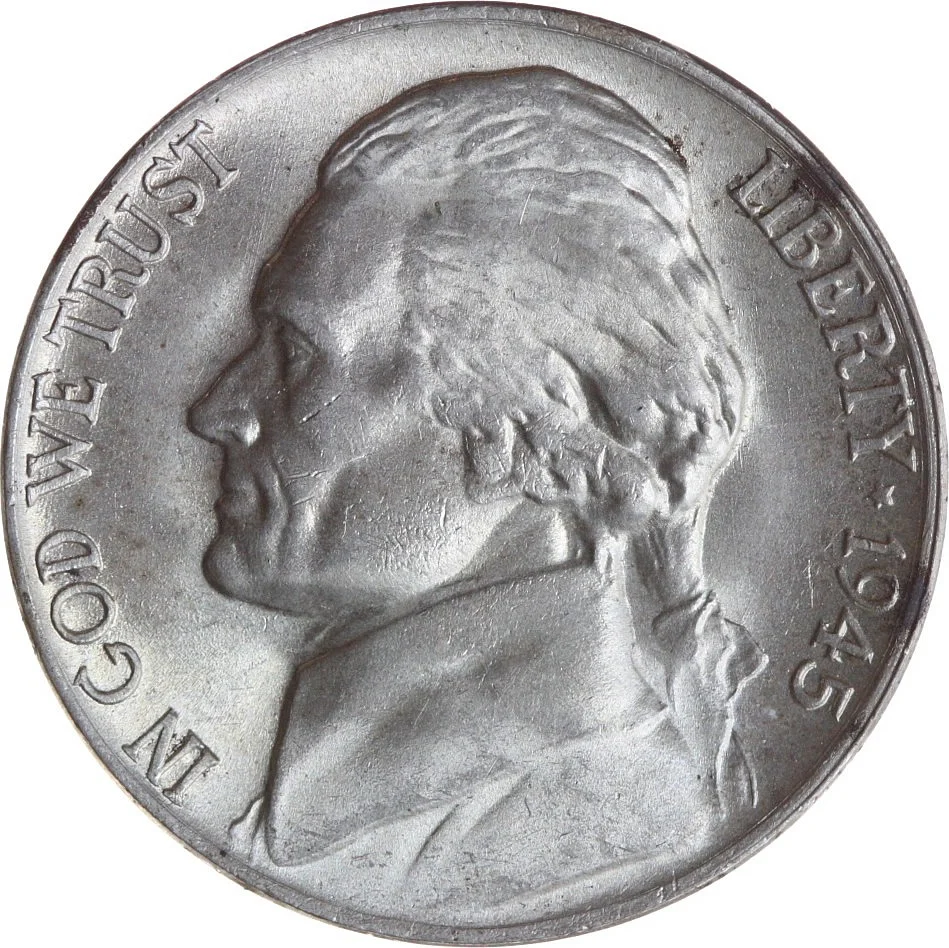
1945-P Jefferson war nickel obverse. Photography by Bobby131313, sourced from Wikimedia Commons (CC BY-SA 3.0).
How to Identify a War Nickel
Identifying a war nickel takes about two seconds — just flip the coin to the reverse and look above the dome of Monticello:
- Check the reverse (back) of the coin. If there is a large mint mark letter ("P," "D," or "S") directly above the dome of Monticello, it is a 35% silver war nickel.
- Check the date. War nickels were produced only in 1942 (partial year), 1943, 1944, and 1945.
- Note the color. Silver war nickels often develop a distinctive dark gray or greenish tinge over time due to the manganese in the alloy. They look different from standard nickels once you know what to look for.
Important: Not all 1942 nickels are silver. The Philadelphia and Denver mints produced both standard and silver compositions in 1942. Only 1942 nickels with the large mint mark above Monticello are silver. A 1942 nickel with a small "D" to the right of Monticello is a standard nickel-copper coin worth face value.
War Nickel Silver Melt Value
Every war nickel contains exactly 0.05626 troy ounces of silver. The melt value fluctuates daily with the silver spot price:
| Silver Spot Price | Melt Value Per Coin | Per Roll (40 coins) |
|---|---|---|
| $24/oz | $1.35 | $54.00 |
| $28/oz | $1.58 | $63.00 |
| $30/oz | $1.69 | $67.50 |
| $32/oz | $1.80 | $72.00 |
| $35/oz | $1.97 | $78.80 |
| $40/oz | $2.25 | $90.00 |
You can check the current silver spot price at Kitco or APMEX. At recent silver prices around $30–$35 per ounce, each war nickel contains roughly $1.69–$1.97 in silver — over 33 times their five-cent face value.
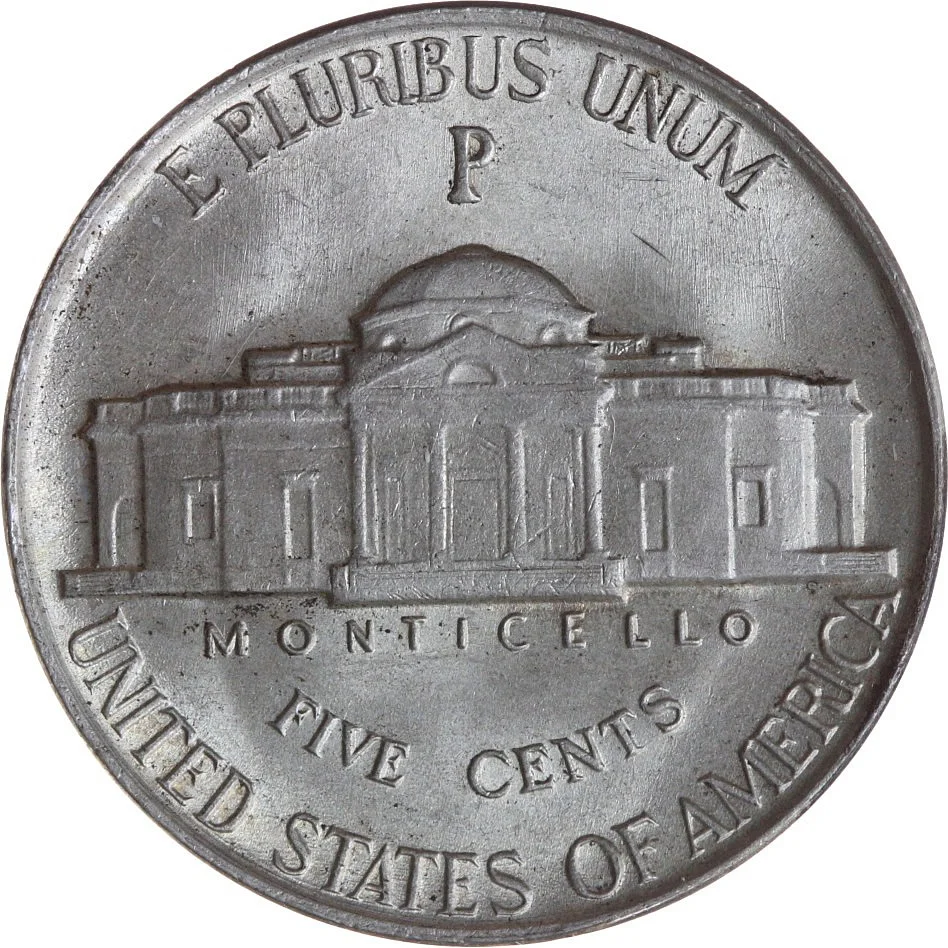
1945-P war nickel reverse — note the oversized "P" mint mark above Monticello's dome. Photography by Bobby131313, sourced from Wikimedia Commons (CC BY-SA 3.0).
War Nickel Value Chart: All Dates and Mint Marks
The following values represent typical retail prices for problem-free coins in each grade. "FS" indicates Full Steps — coins with at least five or six complete, unbroken steps on Monticello's base, which command substantial premiums.
1942 War Nickels
The 1942 silver nickels were produced for only part of the year (October–December), resulting in lower mintages than subsequent wartime years. The 1942-P is notable as the very first U.S. coin to bear a Philadelphia mint mark.
| Date | Mintage | G-4 | VF-20 | MS-63 | MS-65 | MS-65 FS |
|---|---|---|---|---|---|---|
| 1942-P (Silver) | 57,900,600 | $2–$3 | $3–$5 | $12–$18 | $30–$50 | $100–$250 |
| 1942-S | 32,900,000 | $2–$3 | $3–$5 | $12–$18 | $35–$55 | $150–$350 |
1943 War Nickels
1943 saw the highest combined war nickel production, with all three mints running at full capacity. The 1943-P is the most common war nickel overall.
| Date | Mintage | G-4 | VF-20 | MS-63 | MS-65 | MS-65 FS |
|---|---|---|---|---|---|---|
| 1943-P | 271,165,000 | $1.50–$2.50 | $2.50–$4 | $8–$14 | $25–$40 | $80–$200 |
| 1943-D | 15,294,000 | $2–$3 | $3–$5 | $15–$25 | $45–$70 | $200–$500 |
| 1943-S | 104,060,000 | $1.50–$2.50 | $2.50–$4 | $10–$16 | $30–$50 | $100–$250 |
The 1943-D has the lowest mintage of the 1943 war nickels and is somewhat scarce in gem grades. Full Steps examples of the 1943-D are genuinely rare.
1944 War Nickels
| Date | Mintage | G-4 | VF-20 | MS-63 | MS-65 | MS-65 FS |
|---|---|---|---|---|---|---|
| 1944-P | 119,150,000 | $1.50–$2.50 | $2.50–$4 | $10–$16 | $28–$45 | $80–$200 |
| 1944-D | 32,309,000 | $2–$3 | $3–$5 | $12–$20 | $35–$55 | $150–$400 |
| 1944-S | 21,640,000 | $2–$3 | $3–$5 | $12–$20 | $35–$60 | $200–$500 |
1945 War Nickels (Final Year)
1945 war nickels are the last silver Jefferson nickels produced. The Mint returned to the standard copper-nickel alloy in 1946.
| Date | Mintage | G-4 | VF-20 | MS-63 | MS-65 | MS-65 FS |
|---|---|---|---|---|---|---|
| 1945-P | 119,408,100 | $1.50–$2.50 | $2.50–$4 | $10–$16 | $28–$45 | $80–$200 |
| 1945-D | 37,158,000 | $2–$3 | $3–$5 | $12–$18 | $32–$50 | $120–$300 |
| 1945-S | 58,939,000 | $1.50–$2.50 | $2.50–$4 | $10–$16 | $30–$50 | $100–$250 |
The 1943/2-P Overdate: The Key Variety
The 1943/2-P overdate is the most valuable regular-issue war nickel variety. It was created when a 1943-dated die was punched over a 1942-dated die, leaving traces of the "2" visible beneath the "3" in the date. The overdate is clearest on higher-grade examples but can often be detected with a loupe on circulated coins.
| Grade | Value Range |
|---|---|
| Good (G-4) | $75–$100 |
| Very Good (VG-8) | $90–$130 |
| Fine (F-12) | $100–$150 |
| Very Fine (VF-20) | $125–$200 |
| Extremely Fine (EF-40) | $175–$300 |
| About Uncirculated (AU-50) | $250–$450 |
| Uncirculated (MS-60) | $350–$600 |
| Choice Uncirculated (MS-63) | $600–$1,200 |
| Gem Uncirculated (MS-65) | $2,500–$5,000 |
| MS-65 Full Steps | $5,000–$10,000+ |
The overdate is listed by both PCGS and NGC as a separate variety. Authentication is recommended for any coin claimed to be a 1943/2-P, as the overdate can be confused with die deterioration or damage. Look for clear remnants of the "2" underlying the "3," especially in the lower loop of the "3."
Other War Nickel Errors and Varieties
War nickels were produced in massive quantities under wartime pressure, leading to numerous error coins and die varieties. The manganese-silver alloy was also harder on dies than the standard composition, creating more die cracks and deterioration than typical.
| Error/Variety | Approximate Value |
|---|---|
| 1943/2-P Overdate | $75–$10,000+ |
| Doubled Die Obverse (various dates) | $25–$500+ |
| Doubled Die Reverse (various dates) | $20–$300+ |
| Off-Center Strike (5–15%) | $20–$100 |
| Off-Center Strike (15–50%) | $50–$500+ |
| Broadstrike (no collar) | $20–$150 |
| Clipped Planchet | $10–$75 |
| Die Cracks (major) | $5–$50 |
| Die Cuds (major breaks) | $25–$200+ |
| Struck-Through (grease/cloth) | $10–$100 |
| Wrong Planchet (struck on cent planchet) | $500–$2,000+ |
| Repunched Mint Marks | $5–$50 |
Repunched mint marks (RPMs) are particularly common among war nickels because the large mint mark was hand-punched into each die. Look for doubling or shifting of the "P," "D," or "S" above Monticello. While most RPMs add modest premiums, dramatic examples with widely separated punches can bring $50–$100+.
War nickel reverse showing the distinctive oversized mint mark. Photo by Cholmes75, sourced from Wikimedia Commons (public domain).
How to Grade War Nickels
Grading war nickels follows the same principles as standard Jefferson nickels, but the wartime alloy creates some unique challenges. The silver-manganese composition tends to show wear differently than copper-nickel, and the alloy is prone to distinctive surface effects.
Key Wear Points
- Jefferson's cheekbone: The highest point on the obverse and the first area to show friction
- Hair above Jefferson's ear: Fine detail that flattens progressively with wear
- "IN GOD WE TRUST": Located to the left of Jefferson's bust; legibility correlates with grade
- Monticello's steps: The four or five steps at the base of Monticello are the key to Full Steps designation
- Monticello's dome and pillars: Show progressive flattening with wear
- "E PLURIBUS UNUM": On the reverse above Monticello
Quick Grading Reference
| Grade | What to Look For |
|---|---|
| Good (G-4) | Jefferson's outline clear, date and mint mark readable, Monticello flat |
| Very Good (VG-8) | Some hair detail visible, Monticello's pillars partially visible |
| Fine (F-12) | Moderate hair detail, Monticello's pillars and windows distinct |
| Very Fine (VF-20) | Most hair detail sharp, cheekbone shows only slight wear |
| Extremely Fine (EF-40) | Nearly full hair detail, light wear on cheekbone only |
| About Uncirculated (AU-50) | Trace wear on cheekbone, substantial original luster |
| Uncirculated (MS-60+) | No wear; graded by luster, strike quality, and contact marks |
Full Steps Designation
The Full Steps (FS) designation is the most significant grading factor for Jefferson nickel values. PCGS requires a minimum of five complete, unbroken steps at the base of Monticello, while NGC requires six steps for their "6 Full Steps" (6FS) designation.
War nickels with Full Steps are considerably scarcer than their non-FS counterparts because:
- The wartime alloy was harder on dies, causing faster deterioration
- Monticello's steps are opposite Jefferson's high-relief portrait, making them a weak point in the strike
- High-speed wartime production prioritized quantity over strike quality
Where to Find War Nickels
War nickels are still out there in everyday circulation and coin accumulations — you just need to know where to look.
Coin Roll Hunting
War nickels occasionally turn up in rolls of nickels from banks. While they're becoming rarer in circulation, dedicated roll hunters still find them. Look for:
- Coins with a darker, slightly greenish appearance compared to standard nickels
- Coins that look or feel slightly different in a roll
- Any nickel dated 1942–1945 (flip to check for the large mint mark)
Estate Sales and Inherited Collections
War nickels are among the most commonly found coins in inherited collections and old coin jars. Many people saved them during and after the war, knowing they contained silver. If you've inherited a collection or found a jar of old coins, checking for war nickels is one of the first things you should do.
Coin Dealers and Online
- APMEX: Sells war nickels individually and in bulk rolls at modest premiums over melt
- Heritage Auctions: The premier auction house for certified key dates and Full Steps examples
- eBay: Wide selection; always buy PCGS/NGC certified for coins over $50
- JM Bullion: Another major dealer for bulk silver war nickels
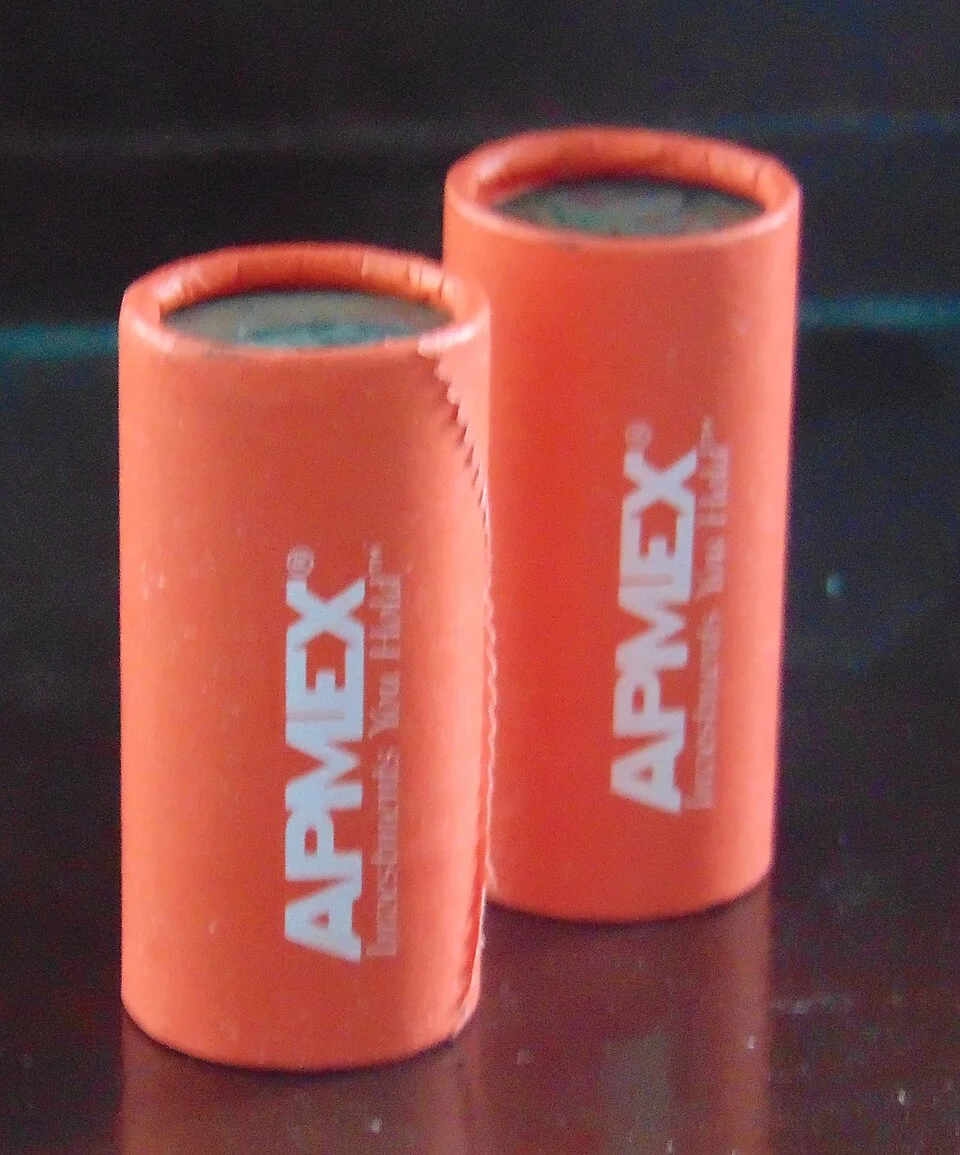
Rolls of 35% silver war nickels. Photo by BrayLockBoy, sourced from Wikimedia Commons (CC BY-SA 4.0).
War Nickel Collecting Strategies
Strategy 1: One of Each Date and Mint (Budget-Friendly)
Collect one war nickel from each date and mint mark combination. With 11 regular issues (1942-P, 1942-S, 1943-P/D/S, 1944-P/D/S, 1945-P/D/S), you can complete this set in circulated condition for $20–$35 total. This is one of the most affordable complete sets in U.S. numismatics.
Strategy 2: Gem Uncirculated Set
Build a set in MS-65 or better. Common dates run $25–$70 each in MS-65, while the 1943-D is the key coin at $45–$70 without Full Steps. Budget approximately $400–$700 for a complete MS-65 set.
Strategy 3: Full Steps Set
The ultimate war nickel challenge. Assembling a complete set in MS-65 with Full Steps is genuinely difficult. Some dates are extremely rare with the FS designation. Budget $1,000–$5,000+ for a complete MS-65 FS set, depending on availability.
Strategy 4: Silver Stacking
Many silver investors buy war nickels in bulk at or near melt value as an affordable way to accumulate physical silver. War nickels trade in rolls of 40 coins (face value $2) and are often available at just a small premium over silver melt value — making them one of the cheapest ways to buy 90% silver U.S. coins by weight.
Estimated Set Costs
| Collection Goal | Estimated Cost |
|---|---|
| One of each date/mint, circulated | $20–$35 |
| Complete set, VF-20 | $30–$50 |
| Complete set, MS-63 | $120–$200 |
| Complete set, MS-65 | $400–$700 |
| Complete set, MS-65 FS | $1,000–$5,000+ |
| Including 1943/2-P overdate, VF-20 | Add $125–$200 |
War Nickels vs. Other Silver Coins
How do war nickels compare to other U.S. silver coins for collectors and investors?
| Coin Type | Silver Content | Typical Circulated Value | Best For |
|---|---|---|---|
| War Nickel (1942–1945) | 35% (0.05626 oz) | $1.50–$3 | Budget collectors, silver stackers |
| Mercury dime (1916–1945) | 90% (0.07234 oz) | $2–$5 | Classic design collectors |
| Roosevelt dime (1946–1964) | 90% (0.07234 oz) | $2–$3 | Silver stackers |
| Washington quarter (1932–1964) | 90% (0.18084 oz) | $5–$8 | General silver investing |
| Walking Liberty half (1916–1947) | 90% (0.36169 oz) | $12–$20 | Design collectors, investors |
| Morgan dollar (1878–1921) | 90% (0.77344 oz) | $25–$40 | Serious collectors |
War nickels offer the lowest entry point for collecting U.S. silver coins, making them ideal for beginners and young collectors. Their silver content is lower per coin than 90% silver dimes, quarters, and half dollars, but bulk purchases at near-melt prices can make them an efficient silver investment.
Storing and Caring for War Nickels
The silver-manganese alloy used in war nickels is more reactive than standard copper-nickel. Proper storage is important to preserve both the coin's appearance and value.
Storage Tips
- Use individual holders for any coin worth more than melt value. 2x2 cardboard flips or plastic capsules work well.
- Avoid PVC-containing holders. Soft plastic flips made of PVC can leave a green residue on coins over time. Use Mylar flips or rigid holders instead.
- Store in a low-humidity environment. The manganese in war nickels makes them prone to tarnishing and surface discoloration.
- Never clean or polish. Cleaning a coin almost always reduces its numismatic value. The natural toning on war nickels is expected and accepted by collectors.
- Handle by edges only. Fingerprint oils accelerate tarnishing on the silver-manganese alloy.
Bulk Storage
For large quantities bought near melt value, storing in original bank-wrapped rolls or canvas bags is acceptable. Serious silver stackers often store war nickel rolls in a fireproof safe or safety deposit box.
Frequently Asked Questions
How much is a war nickel worth?
Most circulated war nickels are worth $1.50–$3 each, based primarily on their 35% silver content. The exact melt value changes daily with the silver spot price. Uncirculated examples bring $8–$50+ depending on date and condition. The key 1943/2-P overdate variety ranges from $75 in low grades to $10,000+ in gem condition with Full Steps.
How do I know if my nickel is a silver war nickel?
Look at the reverse (back) of the coin. If there is a large letter ("P," "D," or "S") above the dome of Monticello, it is a 35% silver war nickel. Standard Jefferson nickels have a smaller mint mark to the right of Monticello (or no visible mint mark for Philadelphia coins). All silver war nickels were produced between 1942 and 1945.
Are war nickels a good investment?
War nickels are one of the most affordable ways to invest in physical silver. They typically trade at small premiums over their silver melt value, making them efficient for silver stacking. As collectibles, key dates and Full Steps examples have shown steady appreciation. The 1943/2-P overdate and scarce FS-designated coins offer the best collectible investment potential.
What is the most valuable war nickel?
The 1943/2-P overdate in MS-65 Full Steps condition is the most valuable war nickel, potentially reaching $10,000 or more. Among regular dates, any war nickel in MS-67 Full Steps grades can bring $500–$5,000+ depending on rarity in that specific date-grade-designation combination.
How many war nickels are in a roll?
A standard roll of nickels contains 40 coins with a face value of $2.00. War nickel rolls contain approximately 2.25 troy ounces of silver total (40 coins × 0.05626 oz each).
Can I still find war nickels in circulation?
Yes, but they are increasingly rare. War nickels do still appear in bank rolls and pocket change occasionally. Your best chances are searching through older rolls from banks, checking inherited coin collections, and looking through change jars at estate sales. Many coin hunters find a few per year through persistent roll searching.
What is the 1943/2-P overdate?
The 1943/2-P overdate was created when a 1942-dated die was re-engraved with a 1943 date, leaving traces of the original "2" visible beneath the "3." It is the most valuable war nickel variety and is recognized by both PCGS and NGC. Authentication by a professional grading service is recommended before buying or selling.
Why do war nickels look different from regular nickels?
The 35% silver and 9% manganese composition gives war nickels a slightly different appearance. They often develop a dark gray, greenish, or even blackish tint over time. This is normal tarnishing caused by the manganese content and does not indicate damage. Many collectors appreciate the distinctive patina as part of the coin's wartime character.
Conclusion
War nickels (1942–1945) represent one of the most accessible and historically significant collecting areas in U.S. numismatics. Every coin tells the story of a nation mobilized for war — even the metal in everyday pocket change was redirected to the military effort. With silver content that makes every example worth more than face value and a complete set achievable for under $50 in circulated grades, war nickels are perfect for beginning collectors. For advanced numismatists, the challenge of assembling a Full Steps set or tracking down the elusive 1943/2-P overdate provides serious depth.
Whether you found a handful of dark-looking nickels in a coin jar or you're building a certified collection, knowing exactly what you have is the first step. Use CoinID to snap a photo of any nickel and instantly identify whether it's a silver war nickel, get its current market value, and learn about any special varieties or errors — all in seconds.