Quick Answer: Most circulated Washington Quarters from 1965–1998 are worth face value (25 cents). Silver Washington Quarters from 1932–1964 are worth at least $4–$6 for their 90% silver content, with common dates in circulated grades bringing $5–$12. Key dates like the 1932-D ($100–$3,500+) and 1932-S ($80–$2,000+) command significant premiums. Certain errors and varieties — including the 1937 doubled-die obverse, 1943/2-P overdate, and State Quarter errors — can be worth $50 to $10,000+.
The Washington Quarter is the longest-running quarter dollar design in United States history, first struck in 1932 to commemorate the 200th anniversary of George Washington's birth and still in production today. Designed by sculptor John Flanagan, the original obverse features a left-facing bust of Washington based on Jean-Antoine Houdon's famous 1786 sculpture. The reverse depicts a heraldic eagle perched on a bundle of arrows with olive branches below. Minted in 90% silver from 1932 through 1964, the series transitioned to copper-nickel clad in 1965 and has undergone multiple reverse design changes — including the iconic 50 State Quarters program (1999–2008), America the Beautiful Quarters (2010–2021), and the American Women Quarters (2022–2025). With billions of coins struck across nearly a century, Washington Quarters offer collectors entry points at every budget level while hiding genuinely valuable key dates, errors, and varieties in pocket change and inherited collections alike.
Washington Quarter Design and Specifications
John Flanagan won the design competition for the new quarter in 1931, beating out Laura Gardin Fraser (whose design was preferred by the Commission of Fine Arts but overruled by Treasury Secretary Andrew Mellon). Flanagan's clean, classical portrait of Washington has become one of the most recognizable coin designs in American history.
| Specification | Silver (1932–1964) | Clad (1965–Present) |
|---|---|---|
| Composition | 90% silver, 10% copper | Copper-nickel clad (75% Cu, 25% Ni over pure Cu core) |
| Weight | 6.25 grams | 5.67 grams |
| Diameter | 24.3 mm | 24.3 mm |
| Edge | Reeded | Reeded |
| Silver Content | 0.1808 troy oz | None |
| Designer | John Flanagan (obverse) | Flanagan obverse through 2021; various reverses |
| Mints | Philadelphia (no mint mark pre-1980, P after), Denver (D), San Francisco (S) | Same plus West Point (W) for special issues |
Design Eras
- 1932–1964 (Silver): Original Flanagan obverse and heraldic eagle reverse. Struck in 90% silver. No mint marks on Philadelphia coins; D and S for branch mints. No quarters struck in 1933.
- 1965–1974 (Clad, No Mint Marks): Same design, new copper-nickel clad composition. Mint marks removed from all coins 1965–1967 to discourage hoarding during the coin shortage.
- 1968–1998 (Clad with Mint Marks): Mint marks returned in 1968 (moved from reverse to obverse behind Washington's ponytail). Philadelphia received "P" mint mark starting 1980.
- 1976 (Bicentennial): Special reverse by Jack L. Ahr featuring a Colonial drummer, dual-dated "1776–1976." Struck in both clad and 40% silver proof/uncirculated versions.
- 1999–2008 (50 State Quarters): William Cousins modified Flanagan's obverse; 50 unique state reverses released five per year in order of statehood.
- 2009 (DC & Territories): Six additional designs for DC, Puerto Rico, Guam, American Samoa, U.S. Virgin Islands, and Northern Mariana Islands.
- 2010–2021 (America the Beautiful): National parks and sites series, 56 designs total.
- 2022–2025 (American Women): Celebrating contributions of American women, with a new Laura Gardin Fraser–inspired obverse by sculptor Luke Jordan.
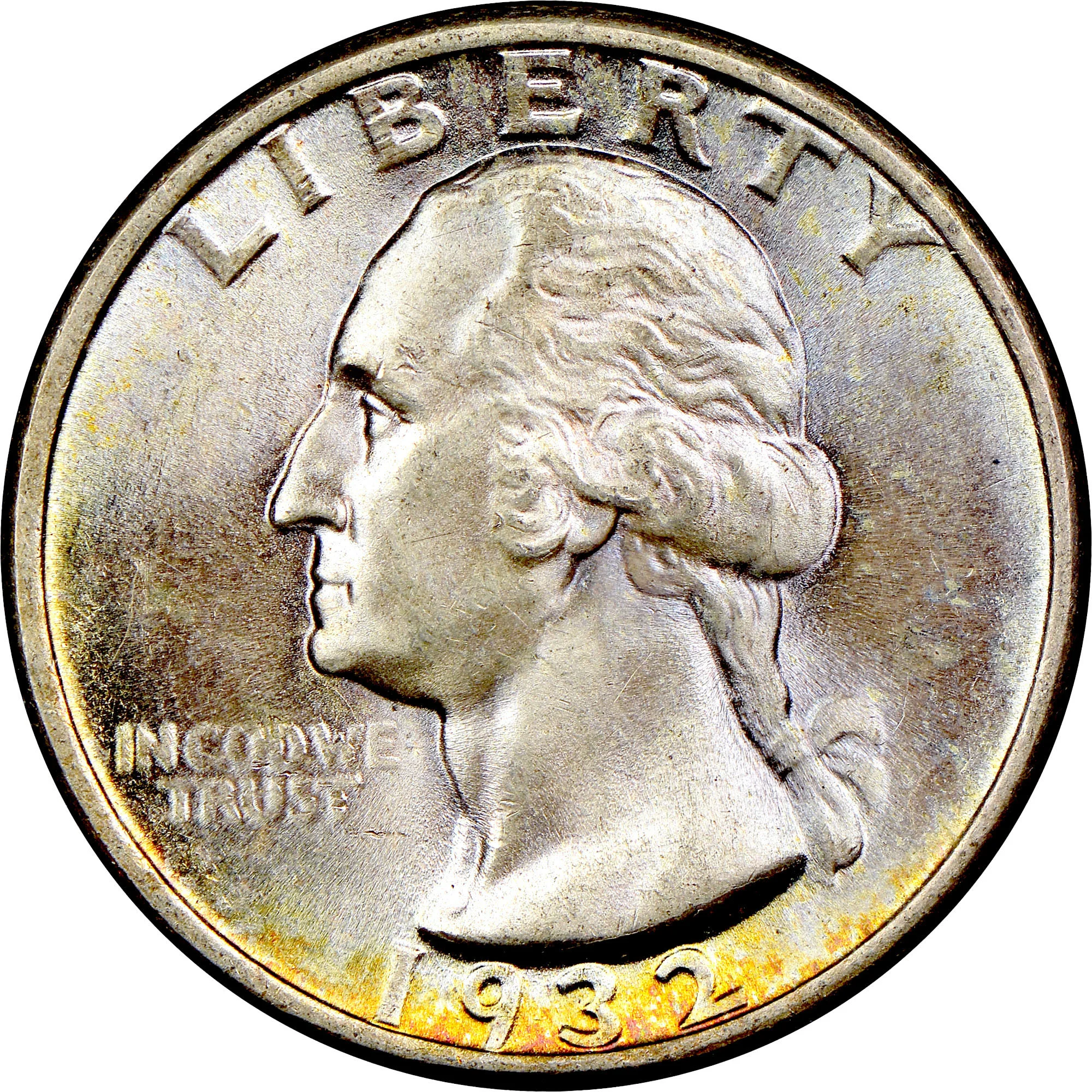
1932 Washington Quarter obverse (MS grade). Photo sourced from Wikimedia Commons (public domain — U.S. currency).
Silver Washington Quarter Values (1932–1964)
Every silver Washington Quarter contains 0.1808 troy ounces of pure silver, establishing a firm melt-value floor. At current silver prices, that floor is approximately $4–$6 per coin. Beyond melt value, collector demand for specific dates, mint marks, and high grades pushes prices considerably higher.
Common-Date Silver Quarter Values
The majority of silver Washington Quarters from the mid-1930s through 1964 are considered common dates. Philadelphia issues from the 1940s–1960s are especially plentiful.
| Grade | Value Range |
|---|---|
| Good (G-4) | $5–$7 (near melt) |
| Very Good (VG-8) | $6–$8 |
| Fine (F-12) | $6–$9 |
| Very Fine (VF-20) | $7–$10 |
| Extremely Fine (EF-40) | $8–$12 |
| About Uncirculated (AU-50) | $10–$18 |
| Uncirculated (MS-60) | $15–$30 |
| Choice Uncirculated (MS-63) | $25–$55 |
| Gem Uncirculated (MS-65) | $50–$150 |
| Superb Gem (MS-67) | $200–$1,000+ |
These ranges cover dates like 1941-P, 1944-D, 1953-P, 1957-D, and 1964-P/D — the bread-and-butter coins that make up the vast majority of surviving silver quarters.
Key Date Washington Quarter Values
The real money in this series lives in a handful of scarce dates from the 1930s. Low mintages, Depression-era hoarding, and genuine scarcity in high grades make these coins highly sought-after.
1932-D Washington Quarter Value
The 1932-D is the undisputed key date of the entire Washington Quarter series. With a mintage of just 436,800 coins — the lowest of any regular-issue Washington Quarter — it was saved by relatively few collectors during the depths of the Great Depression. Circulated examples are genuinely scarce, and uncirculated specimens are rare.
| Grade | Value Range |
|---|---|
| Good (G-4) | $100–$150 |
| Very Good (VG-8) | $125–$175 |
| Fine (F-12) | $150–$225 |
| Very Fine (VF-20) | $200–$325 |
| Extremely Fine (EF-40) | $350–$550 |
| About Uncirculated (AU-50) | $500–$800 |
| Uncirculated (MS-60) | $800–$1,200 |
| Choice Uncirculated (MS-63) | $1,500–$2,500 |
| Gem Uncirculated (MS-65) | $3,000–$6,000+ |
Authentication through PCGS or NGC is recommended for any 1932-D, as altered mint marks (adding a "D" to a common 1932 Philadelphia coin) are a known counterfeiting concern.
1932-S Washington Quarter Value
The 1932-S has the second-lowest mintage in the series at 408,000 coins. While slightly more available than the 1932-D in lower grades (more were saved by West Coast collectors), it remains a genuine key date that commands strong premiums.
| Grade | Value Range |
|---|---|
| Good (G-4) | $80–$120 |
| Very Good (VG-8) | $100–$150 |
| Fine (F-12) | $125–$175 |
| Very Fine (VF-20) | $150–$250 |
| Extremely Fine (EF-40) | $225–$375 |
| About Uncirculated (AU-50) | $350–$550 |
| Uncirculated (MS-60) | $600–$900 |
| Choice Uncirculated (MS-63) | $1,000–$1,800 |
| Gem Uncirculated (MS-65) | $2,500–$5,000+ |
Other Semi-Key Dates (1930s)
Several other 1930s dates carry notable premiums due to low mintages and Depression-era scarcity:
| Date | Mintage | VF-20 | MS-63 | MS-65 |
|---|---|---|---|---|
| 1932 (no mint mark) | 5,404,000 | $8–$12 | $50–$100 | $200–$500 |
| 1934 | 31,912,052 | $7–$10 | $30–$55 | $100–$250 |
| 1934-D | 3,527,200 | $15–$30 | $150–$350 | $750–$2,000 |
| 1935-D | 5,780,000 | $10–$18 | $75–$175 | $400–$1,000 |
| 1935-S | 5,660,000 | $10–$20 | $100–$225 | $500–$1,200 |
| 1936-D | 5,374,000 | $12–$25 | $125–$275 | $600–$1,500 |
| 1937-S | 1,652,000 | $15–$30 | $100–$225 | $500–$1,200 |
| 1938-S | 3,180,000 | $15–$25 | $100–$200 | $400–$900 |
Note: No Washington Quarters were struck in 1933 at any mint.
Complete Silver Washington Quarter Value by Year
1932–1939: Depression-Era Scarcity
The 1930s produced the scarcest dates in the series. Low mintages, economic hardship, and limited collector interest at the time mean fewer coins survived in collectible condition.
| Date | Mint | Mintage | G-4 | VF-20 | MS-63 |
|---|---|---|---|---|---|
| 1932 | P | 5,404,000 | $6–$8 | $8–$12 | $50–$100 |
| 1932-D | D | 436,800 | $100–$150 | $200–$325 | $1,500–$2,500 |
| 1932-S | S | 408,000 | $80–$120 | $150–$250 | $1,000–$1,800 |
| 1934 | P | 31,912,052 | $5–$7 | $7–$10 | $30–$55 |
| 1934-D | D | 3,527,200 | $6–$9 | $15–$30 | $150–$350 |
| 1935 | P | 32,484,000 | $5–$7 | $7–$10 | $25–$45 |
| 1935-D | D | 5,780,000 | $6–$8 | $10–$18 | $75–$175 |
| 1935-S | S | 5,660,000 | $6–$8 | $10–$20 | $100–$225 |
| 1936 | P | 41,300,000 | $5–$7 | $7–$10 | $25–$45 |
| 1936-D | D | 5,374,000 | $6–$9 | $12–$25 | $125–$275 |
| 1936-S | S | 3,828,000 | $6–$8 | $10–$20 | $75–$175 |
| 1937 | P | 19,696,000 | $5–$7 | $7–$12 | $30–$55 |
| 1937-D | D | 7,189,600 | $6–$8 | $10–$18 | $50–$100 |
| 1937-S | S | 1,652,000 | $7–$12 | $15–$30 | $100–$225 |
| 1938 | P | 9,472,000 | $6–$8 | $8–$15 | $40–$75 |
| 1938-S | S | 3,180,000 | $6–$9 | $15–$25 | $100–$200 |
| 1939 | P | 33,540,000 | $5–$7 | $7–$10 | $20–$40 |
| 1939-D | D | 7,092,000 | $6–$8 | $8–$15 | $30–$55 |
| 1939-S | S | 2,628,000 | $6–$9 | $12–$22 | $75–$175 |
1940–1949: Wartime and Post-War Production
Mintages surged during World War II as economic activity increased. These dates are generally affordable in circulated grades but can be surprisingly scarce in gem uncirculated condition due to wartime handling and storage conditions.
| Date | Mint | Mintage | G-4 | VF-20 | MS-63 |
|---|---|---|---|---|---|
| 1940 | P | 35,704,000 | $5–$7 | $7–$10 | $18–$35 |
| 1940-D | D | 2,797,600 | $6–$8 | $10–$18 | $55–$110 |
| 1940-S | S | 8,244,000 | $5–$7 | $7–$12 | $30–$55 |
| 1941 | P | 79,032,000 | $5–$7 | $7–$10 | $15–$30 |
| 1941-D | D | 16,714,800 | $5–$7 | $7–$10 | $20–$40 |
| 1941-S | S | 16,080,000 | $5–$7 | $7–$12 | $25–$45 |
| 1942 | P | 102,096,000 | $5–$7 | $7–$10 | $15–$30 |
| 1942-D | D | 17,487,200 | $5–$7 | $7–$10 | $20–$40 |
| 1942-S | S | 19,384,000 | $5–$7 | $7–$10 | $20–$40 |
| 1943 | P | 99,700,000 | $5–$7 | $7–$10 | $15–$30 |
| 1943-D | D | 16,095,600 | $5–$7 | $7–$10 | $20–$40 |
| 1943-S | S | 21,700,000 | $5–$7 | $7–$10 | $18–$35 |
| 1944 | P | 104,956,000 | $5–$7 | $7–$10 | $15–$28 |
| 1944-D | D | 14,600,800 | $5–$7 | $7–$10 | $18–$35 |
| 1944-S | S | 12,560,000 | $5–$7 | $7–$10 | $18–$35 |
| 1945 | P | 74,372,000 | $5–$7 | $7–$10 | $15–$28 |
| 1945-D | D | 12,341,600 | $5–$7 | $7–$10 | $18–$35 |
| 1945-S | S | 17,004,001 | $5–$7 | $7–$10 | $18–$35 |
| 1946 | P | 53,436,000 | $5–$7 | $7–$10 | $15–$28 |
| 1946-D | D | 9,072,800 | $5–$7 | $7–$10 | $18–$35 |
| 1946-S | S | 4,204,000 | $5–$7 | $7–$12 | $22–$45 |
| 1947 | P | 22,556,000 | $5–$7 | $7–$10 | $18–$35 |
| 1947-D | D | 15,338,400 | $5–$7 | $7–$10 | $18–$35 |
| 1947-S | S | 5,532,000 | $5–$7 | $7–$12 | $22–$45 |
| 1948 | P | 35,196,000 | $5–$7 | $7–$10 | $18–$35 |
| 1948-D | D | 16,766,800 | $5–$7 | $7–$10 | $18–$35 |
| 1948-S | S | 15,960,000 | $5–$7 | $7–$10 | $18–$35 |
| 1949 | P | 9,312,000 | $5–$7 | $8–$14 | $35–$65 |
| 1949-D | D | 10,068,400 | $5–$7 | $8–$12 | $30–$55 |
1950–1964: The Final Silver Years
The 1950s and early 1960s saw enormous mintages, especially from Philadelphia and Denver. The 1964 date — the last year of silver quarters — had the highest mintage in the series as the U.S. Mint attempted to meet surging demand before the switch to clad coinage.
| Date | Mint | Mintage | G-4 | VF-20 | MS-63 |
|---|---|---|---|---|---|
| 1950 | P | 24,920,126 | $5–$7 | $7–$10 | $20–$40 |
| 1950-D | D | 21,075,600 | $5–$7 | $7–$10 | $18–$35 |
| 1950-S | S | 10,284,004 | $5–$7 | $7–$10 | $20–$40 |
| 1951 | P | 43,448,102 | $5–$7 | $7–$10 | $15–$30 |
| 1951-D | D | 35,354,800 | $5–$7 | $7–$10 | $15–$30 |
| 1951-S | S | 9,048,000 | $5–$7 | $7–$12 | $25–$50 |
| 1952 | P | 38,780,093 | $5–$7 | $7–$10 | $15–$30 |
| 1952-D | D | 49,795,200 | $5–$7 | $7–$10 | $15–$28 |
| 1952-S | S | 13,707,800 | $5–$7 | $7–$10 | $18–$35 |
| 1953 | P | 18,536,120 | $5–$7 | $7–$10 | $18–$35 |
| 1953-D | D | 56,112,400 | $5–$7 | $7–$10 | $15–$28 |
| 1953-S | S | 14,016,000 | $5–$7 | $7–$10 | $18–$35 |
| 1954 | P | 54,412,203 | $5–$7 | $7–$10 | $15–$28 |
| 1954-D | D | 42,305,500 | $5–$7 | $7–$10 | $15–$28 |
| 1954-S | S | 11,834,722 | $5–$7 | $7–$10 | $18–$35 |
| 1955 | P | 18,180,181 | $5–$7 | $7–$10 | $18–$35 |
| 1955-D | D | 3,182,400 | $5–$7 | $8–$15 | $30–$60 |
| 1956 | P | 44,144,000 | $5–$7 | $7–$10 | $15–$28 |
| 1956-D | D | 32,334,500 | $5–$7 | $7–$10 | $15–$28 |
| 1957 | P | 46,532,000 | $5–$7 | $7–$10 | $15–$28 |
| 1957-D | D | 77,924,160 | $5–$7 | $7–$10 | $12–$25 |
| 1958 | P | 6,360,000 | $5–$7 | $8–$12 | $22–$45 |
| 1958-D | D | 78,124,900 | $5–$7 | $7–$10 | $12–$25 |
| 1959 | P | 24,384,000 | $5–$7 | $7–$10 | $15–$28 |
| 1959-D | D | 62,054,232 | $5–$7 | $7–$10 | $12–$25 |
| 1960 | P | 29,164,000 | $5–$7 | $7–$10 | $12–$25 |
| 1960-D | D | 63,000,324 | $5–$7 | $7–$10 | $12–$25 |
| 1961 | P | 37,036,000 | $5–$7 | $7–$10 | $12–$25 |
| 1961-D | D | 83,656,928 | $5–$7 | $7–$10 | $12–$25 |
| 1962 | P | 36,156,000 | $5–$7 | $7–$10 | $12–$25 |
| 1962-D | D | 127,554,756 | $5–$7 | $7–$10 | $12–$25 |
| 1963 | P | 74,316,000 | $5–$7 | $7–$10 | $12–$25 |
| 1963-D | D | 135,288,184 | $5–$7 | $7–$10 | $12–$25 |
| 1964 | P | 560,390,585 | $5–$7 | $7–$10 | $12–$22 |
| 1964-D | D | 704,135,528 | $5–$7 | $7–$10 | $12–$22 |
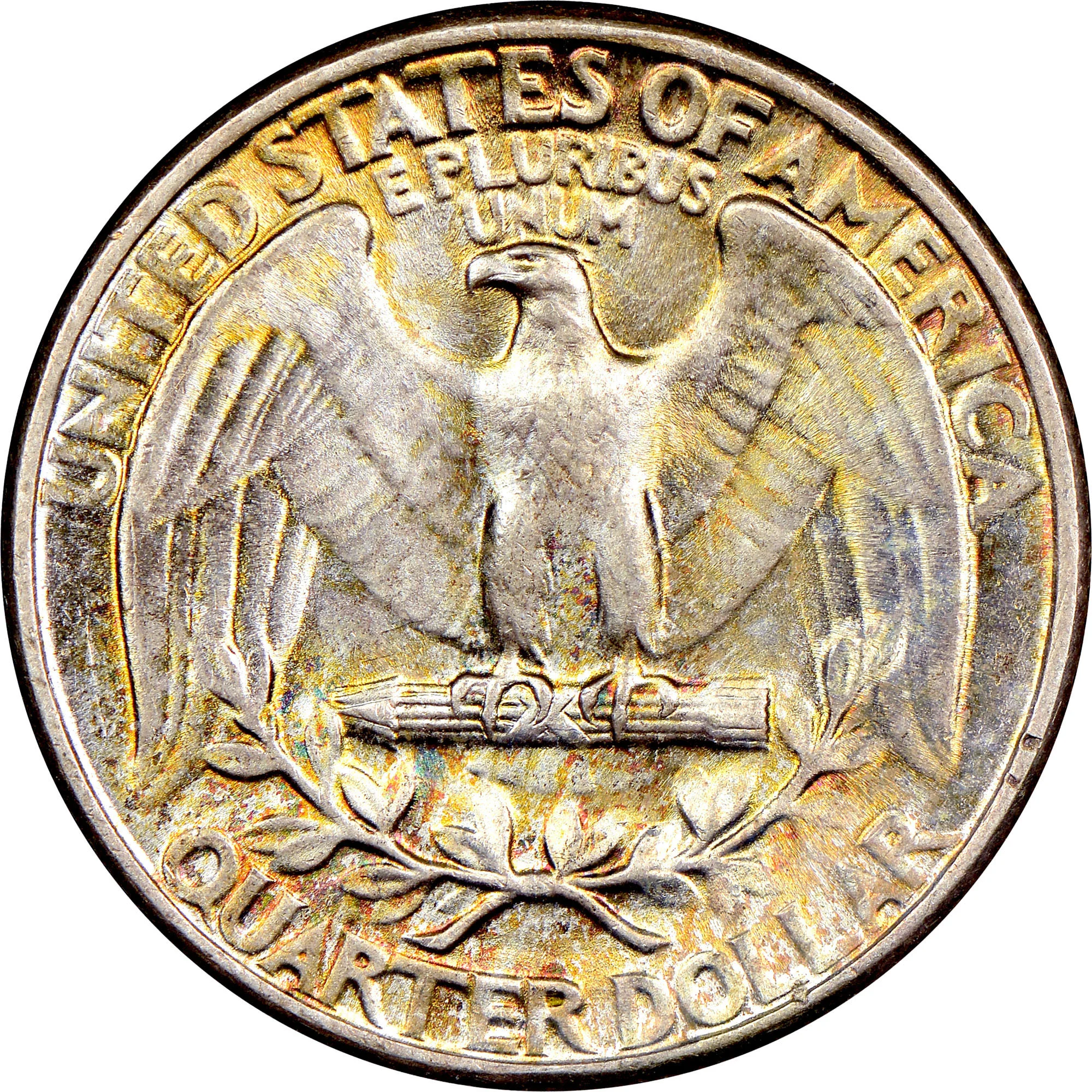
1932 Washington Quarter reverse. Photo sourced from Wikimedia Commons (public domain — U.S. currency).
Clad Washington Quarter Values (1965–1998)
The switch to copper-nickel clad composition in 1965 eliminated the silver content that had provided a value floor. Clad Washington Quarters from 1965–1998 are worth face value (25 cents) in circulated condition with very few exceptions. However, uncirculated examples — especially those graded MS-66 or higher — do carry collector premiums.
When Clad Quarters Are Worth More Than Face Value
| Condition | Value |
|---|---|
| Circulated (any grade) | $0.25 (face value) |
| Uncirculated (MS-63) | $1–$3 |
| Choice Uncirculated (MS-65) | $5–$15 |
| Gem (MS-66) | $15–$40 |
| Superb Gem (MS-67) | $40–$200+ |
| MS-68 or higher | $200–$2,000+ |
The most valuable clad-era regular issues tend to be coins from the late 1960s and early 1970s that survived in exceptional condition. The 1966, 1967, and some early-1970s issues graded MS-67 can bring $100–$300+ due to their scarcity in top grades.
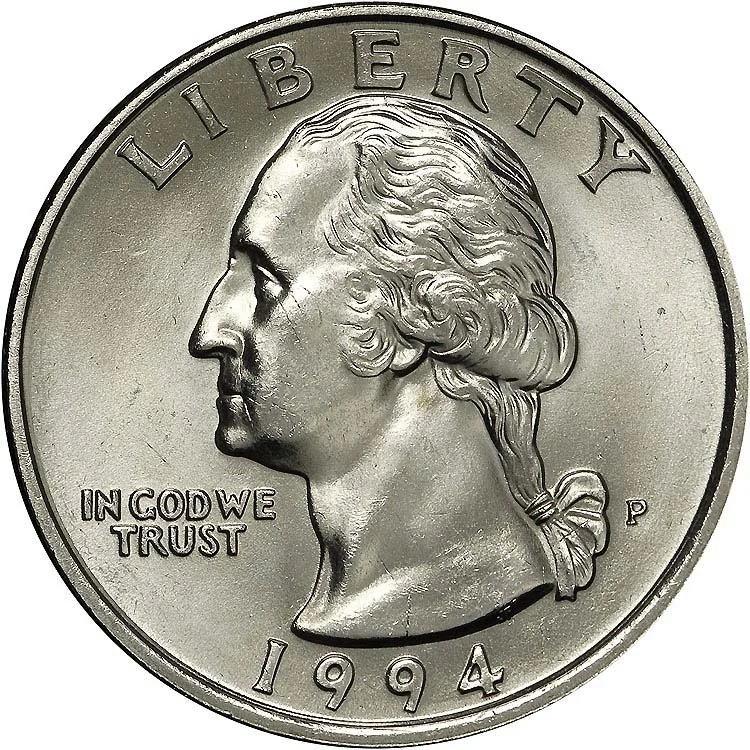
1994-P Washington Quarter obverse (clad era). Photo sourced from Wikimedia Commons (public domain — U.S. currency).
State Quarters and Modern Issues (1999–Present)
The 50 State Quarters program (1999–2008) ignited a collecting craze that brought millions of new people into coin collecting. Most State Quarters are worth face value in circulated condition, but certain errors, proofs, and silver versions carry premiums.
State Quarter Values
| Type | Value |
|---|---|
| Circulated State Quarter (any state) | $0.25 |
| Uncirculated State Quarter (MS-63) | $0.50–$2 |
| Gem Uncirculated (MS-66+) | $5–$25 |
| Silver Proof State Quarter | $5–$12 |
| Clad Proof State Quarter | $1–$3 |
Valuable State Quarter Errors
State Quarter errors are among the most actively collected modern coins. The massive mintages mean many errors escaped the Mint's quality control:
| Error Type | Estimated Value |
|---|---|
| Wisconsin Extra Leaf (High or Low), 2004-D | $50–$300+ |
| Minnesota Extra Tree, 2005-P | $25–$150 |
| Kansas "In God We Rust" (filled die), 2005-D | $25–$100 |
| Wyoming Double-Die Reverse, 2007-D | $25–$75 |
| Rotated Die (any state, 45°+ rotation) | $25–$150+ |
| Off-Center Strike (10%+) | $25–$200+ |
| Broadstrike (no collar) | $20–$75 |
| Wrong Planchet (struck on dime or cent blank) | $500–$3,000+ |
America the Beautiful and American Women Quarters
These modern series (2010–present) generally trade at face value in circulation. Silver proof versions, early-release coins graded MS-67 or higher, and errors carry modest premiums. The W-mint-mark quarters released into circulation starting in 2019 were intentionally limited and can bring $5–$25 in uncirculated condition.
Errors and Varieties Worth Money
Washington Quarter errors span the entire series and represent some of the most valuable coins you might find in pocket change or an old collection.
Silver-Era Errors (1932–1964)
| Error/Variety | Date | Value Range |
|---|---|---|
| 1937 Doubled-Die Obverse | 1937-P | $100–$3,000+ |
| 1942-D Doubled-Die Obverse | 1942-D | $75–$1,500+ |
| 1943/2-P Overdate | 1943-P | $50–$800+ |
| 1950-D/S Over Mint Mark | 1950-D | $25–$250+ |
| 1950-S/D Over Mint Mark | 1950-S | $25–$250+ |
| Off-Center Strikes (5–15%) | Various | $30–$300+ |
| Clipped Planchets | Various | $15–$100 |
| Wrong Planchet (struck on dime) | Various | $500–$5,000+ |
Clad-Era Errors (1965–Present)
| Error/Variety | Date | Value Range |
|---|---|---|
| 1965 Struck on Silver Planchet | 1965 | $7,000–$12,000+ |
| 1970-D Struck Over 1941 Canadian Quarter | 1970-D | $10,000–$20,000+ |
| 1969-D Struck on Nickel Planchet | 1969-D | $500–$2,000 |
| Missing Clad Layer (one or both sides) | Various | $50–$300 |
| Struck Through (grease, cloth, wire) | Various | $15–$100 |
| Major Die Cracks/Cuds | Various | $25–$300+ |
Transitional Errors (1964–1965)
The most exciting Washington Quarter errors are transitional pieces from the 1964–1965 changeover period. A 1965 quarter struck on a leftover 90% silver planchet is worth $7,000–$12,000+ because it shouldn't exist — the Mint was supposed to use only clad planchets starting in 1965. These coins can be identified by their different edge appearance (silver edge vs. copper-nickel sandwich visible on clad coins) and their weight (6.25g for silver vs. 5.67g for clad).
How to Grade Washington Quarters
The Sheldon scale runs from 1 to 70 and is the industry standard for grading U.S. coins.
Key Wear Points
- Washington's hair detail: The high points above the ear and along the forehead show wear first — look for loss of individual hair strands
- Cheekbone: The area from the ear to the nose flattens early in circulation
- Eagle's breast feathers: On the reverse, the eagle's chest is the first area to lose detail
- Wing tips: Wear shows quickly on the tips and edges of the eagle's wings
- Motto lettering: "IN GOD WE TRUST" and "LIBERTY" can lose sharpness on well-circulated examples
Quick Grading Reference
| Grade | What to Look For |
|---|---|
| Good (G-4) | Major design elements visible but flat; date and mint mark clear; rim intact |
| Very Good (VG-8) | Some hair detail visible at back of head; motto letters clear though flat |
| Fine (F-12) | Hair detail shows above ear and along forehead; eagle's feathers partially visible |
| Very Fine (VF-20) | Most hair strands sharp; moderate wear on high points; eagle shows clear feather definition |
| Extremely Fine (EF-40) | Light wear on highest points only; nearly full hair detail; eagle's breast feathers clearly defined |
| About Uncirculated (AU-50) | Trace wear on cheekbone and hair above ear; substantial original luster |
| Uncirculated (MS-60+) | No wear; graded by luster quality, strike sharpness, and surface marks |
Strike Quality
Washington Quarters, particularly those from the 1950s and 1960s, can suffer from weak strikes. Look for full hair detail, sharp eagle feathers, and complete motto lettering. Weakly struck coins are worth less than well-struck examples of the same date and grade, particularly in the MS-65 and higher range where collectors are more discriminating.
Silver Melt Value
Every 1932–1964 Washington Quarter contains 0.1808 troy ounces of silver. This silver content provides a guaranteed minimum value that moves with the precious metals market.
| Silver Price per Troy Oz | Quarter Melt Value |
|---|---|
| $25 | $4.52 |
| $30 | $5.42 |
| $35 | $6.33 |
| $40 | $7.23 |
| $45 | $8.14 |
| $50 | $9.04 |
The 1976-S Bicentennial silver quarter (struck in 40% silver, 0.0739 oz silver content) has a lower melt value of approximately $1.80–$3.70 depending on silver prices, but carries a collector premium of $5–$15 regardless.
Washington Quarter Collecting Strategies
Strategy 1: Silver Type Coin (Budget-Friendly)
Buy a single silver Washington Quarter in VG to VF condition to represent the series. Cost: $6–$10. This is ideal for type-set collectors who want one example of each major U.S. coin design.
Strategy 2: One Per Year (Moderate Budget)
Collect one quarter from each year minted (1932–1964, excluding 1933). In Fine to VF grades, this set of 32 coins can be assembled for approximately $250–$500, with the 1932-D and 1932-S accounting for most of the cost. Skip those two key dates initially and fill them in later to spread the expense.
Strategy 3: Complete by Date and Mint Mark
A full date-and-mint-mark set of silver Washington Quarters comprises approximately 83 coins. In circulated grades (VG to Fine), expect to spend $1,500–$4,000 total, with the 1932-D and 1932-S representing the biggest investments.
Strategy 4: Full State Quarter Set
Assembling all 50 State Quarters (plus 6 DC/Territories) in uncirculated condition is an achievable goal that many collectors pursue. Sets in MS-63 to MS-65 can be built for $50–$150 from rolls, Mint sets, or individual purchases.
Strategy 5: Registry Set (Advanced)
Building a high-grade PCGS or NGC registry set of Washington Quarters is a serious numismatic endeavor. Top-pop examples of key dates command five- and six-figure prices, and competition among registry collectors drives prices steadily higher.
Estimated Budget by Completion Level
| Collection Goal | Estimated Cost |
|---|---|
| Type coin (1 silver quarter, VG-VF) | $6–$10 |
| One per year (excl. 1932-D/S), Fine | $150–$300 |
| Complete date/mint silver set, VG-Fine | $1,500–$4,000 |
| Complete date/mint silver set, MS-63 | $8,000–$20,000+ |
| Complete State Quarter set, MS-65 | $50–$150 |
| Full series (1932–present), circulated/unc | $2,500–$6,000+ |
Where to Buy Washington Quarters
Coin Dealers and Shows
Established coin dealers stock silver Washington Quarters regularly, particularly common dates in rolls or bags. Regional coin shows and the ANA World's Fair of Money are excellent venues for finding key dates and comparing prices from multiple dealers.
Online Auctions and Marketplaces
- Heritage Auctions: Premier auction house for certified Washington Quarters, especially key dates and high-grade registry coins
- eBay: Wide selection from common dates to key dates — always buy PCGS or NGC certified coins for purchases over $50
- Great Collections: Online auction site specializing in certified U.S. coins at competitive prices
Rolls and Bags
Silver Washington Quarters are commonly sold in rolls (40 coins) or bags. Generic silver quarter rolls (unsearched common dates) typically sell for a modest premium over melt value and are a cost-effective way to acquire silver content while occasionally finding semi-key dates.
Estate Sales and Inherited Collections
Washington Quarters are among the most commonly found coins in inherited collections — from jars of loose silver quarters to carefully assembled albums. If you've inherited a collection, identifying dates and mint marks is the first step. The 1932-D and 1932-S are the coins you're hoping to find, but even common silver dates have intrinsic value. CoinID can instantly identify each coin from a photo, saving hours of manual sorting and giving you current market values.
Washington Quarter Investment Outlook
Washington Quarters offer strong fundamentals across multiple market segments:
- Silver content: Every pre-1965 coin contains nearly a fifth of an ounce of silver, providing a hard floor that rises with precious metal prices
- Key date scarcity: The 1932-D and 1932-S have fixed, limited supplies and consistent collector demand — prices have appreciated steadily over decades
- Condition rarity: Common dates become genuinely rare in MS-67 and above; these condition-census coins have shown strong appreciation
- State Quarter nostalgia: As the generation that collected State Quarters from circulation matures, demand for high-grade and error examples is expected to increase
- Enormous collector base: The Washington Quarter series has one of the largest followings in U.S. numismatics, supporting deep and liquid markets
- Accessibility: Entry points start at pocket change for modern issues, making this series ideal for new collectors building lifelong habits
Frequently Asked Questions
How much is a Washington Quarter worth?
Silver Washington Quarters (1932–1964) are worth at least $4–$6 for their silver content, with common circulated dates bringing $5–$12. Key dates like the 1932-D ($100–$3,500+) and 1932-S ($80–$2,000+) are significantly more valuable. Clad quarters (1965–present) are generally worth face value unless uncirculated, a proof, or an error coin.
What year quarters are silver?
Washington Quarters from 1932 through 1964 are struck in 90% silver. All quarters from 1965 onward are copper-nickel clad (except special Mint issues like silver proofs and the 1976-S Bicentennial 40% silver version). You can quickly identify silver quarters by looking at the edge — silver quarters have a solid silver edge, while clad quarters show a visible copper-nickel sandwich.
What is the most valuable Washington Quarter?
The 1932-D in gem uncirculated condition (MS-65 or higher) is the most valuable regular-issue Washington Quarter, with specimens selling for $3,000–$10,000+. Among errors, the 1965 quarter struck on a silver planchet and the 1970-D struck over a 1941 Canadian quarter are worth $10,000–$20,000+.
Are State Quarters worth anything?
Most circulated State Quarters are worth face value (25 cents). However, certain errors are genuinely valuable — the 2004-D Wisconsin Extra Leaf variety can bring $50–$300+, and wrong-planchet strikes are worth $500–$3,000+. Silver proof State Quarters are worth $5–$12 each.
How can I tell if my quarter is silver?
Check the date first — 1964 and earlier means silver. Then look at the edge: silver quarters have a uniform silver-gray edge, while clad quarters show a distinct copper stripe sandwiched between nickel layers. Silver quarters also weigh more (6.25g vs. 5.67g for clad). CoinID can instantly identify whether your quarter is silver or clad from a photograph.
Where is the mint mark on a Washington Quarter?
On silver-era quarters (1932–1964), the mint mark is on the reverse, below the eagle's tail feathers and above the "QUARTER DOLLAR" inscription. Starting in 1968, the mint mark moved to the obverse, behind Washington's ponytail just below "IN GOD WE TRUST." No mint marks appeared on any coins from 1965–1967.
Should I clean my silver Washington Quarters?
Never clean your coins. Cleaning removes the natural toning and luster that collectors value, and cleaned coins are worth 30–60% less than original, untouched examples. Even gentle cleaning with soap and water can leave micro-scratches visible under magnification. Professional grading services like PCGS and NGC penalize or refuse to grade cleaned coins.
Is a 1964 quarter worth more than other silver quarters?
The 1964 Washington Quarter has the highest mintage of any date in the series (over 1.2 billion coins combined P and D), so it carries no scarcity premium. However, it is worth its silver content ($4–$6+) like any other pre-1965 quarter. In uncirculated condition, common-date 1964 quarters bring $12–$22.
What is the 1976 Bicentennial quarter worth?
The standard clad Bicentennial quarter (dual-dated "1776–1976") is worth face value in circulated condition. Uncirculated examples bring $1–$3. The 40% silver version (1976-S, with an "S" mint mark) is worth $5–$15 depending on condition. Proof versions in original packaging bring similar premiums.
Are W mint mark quarters valuable?
West Point (W) mint mark quarters, released into general circulation starting in 2019, were produced in limited quantities to generate collecting interest. Uncirculated examples typically bring $5–$25, with the earliest releases and highest grades commanding the best premiums.
Conclusion
The Washington Quarter series (1932–present) spans nearly a century of American coinage and offers something for every collector and budget level — from affordable silver type coins and the fun of State Quarter collecting to the serious numismatic challenge of assembling a complete date-and-mint-mark set with key dates like the 1932-D and 1932-S. The series rewards careful examination: transitional errors from the 1964–1965 changeover period, State Quarter varieties, and overlooked condition rarities in common dates all hide in collections and coin jars waiting to be discovered. Whether you're searching through inherited quarters or strategically building a registry set, understanding which dates, mint marks, and conditions carry premiums is essential knowledge. Use CoinID to instantly identify your Washington Quarters, assess their condition, and get current market values — just snap a photo and let the app do the work.